
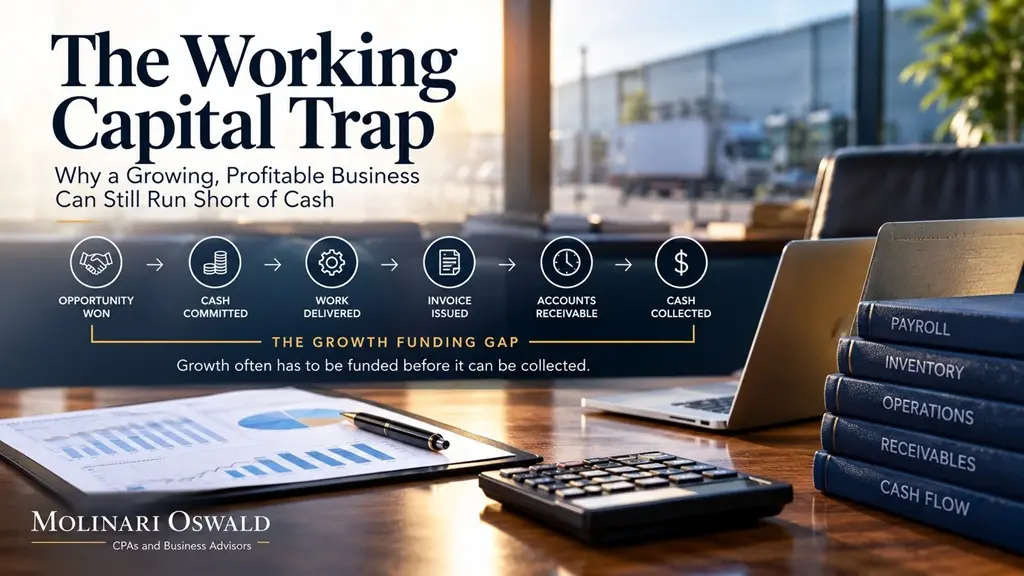
A business can be profitable, growing, winning new customers, adding employees, and increasing revenue and still feel like cash is getting tighter.
That can be confusing.
If sales are increasing and the business is profitable, shouldn’t there be more cash available?
Not necessarily.
Growth often requires a business to spend money before the revenue created by that spending becomes available cash. New employees have to be paid. Materials may need to be purchased. Inventory may increase. Vendors and subcontractors may require payment. Equipment and operating capacity may need to expand.
Meanwhile, the business may still be waiting to complete the work, issue an invoice, or collect from the customer.
That creates one of the most important financial realities of growth:
Growth can create a cash requirement before it creates cash.
The question isn’t only whether growth will be profitable.
It’s whether the business can finance the path between opportunity and payment.
Why Can a Profitable Business Still Run Short of Cash?
Profit and available cash are related, but they are not the same thing.
A business can earn revenue and report a profit before the related cash is actually collected. At the same time, cash may already have gone out the door to support that revenue.
Consider a company that wins a large new contract.
The contract is expected to be profitable. But before the customer pays, the company may need to hire employees, purchase materials, use subcontractors, increase inventory, or absorb other operating costs.
The opportunity may ultimately create profit.
The business still needs enough cash to carry those costs until payment arrives.
Profitability tells you whether the business is creating economic value. It does not automatically tell you how much cash is available today.
For a growing business, understanding that distinction can become just as important as understanding the profit itself.
What Working Capital Really Means for a Growing Business
Working capital is commonly calculated as current assets minus current liabilities.
That calculation is useful, but business owners also need to understand what working capital means operationally.
A more practical question is:
How much money is tied up operating the business before it comes back as usable cash?
Cash may be tied up in accounts receivable, inventory, materials, work in progress, deposits, and other short-term operating needs.
At the same time, the business still has obligations such as payroll, vendor payments, debt payments, taxes, insurance, rent, and other operating expenses.
For businesses that carry inventory or sell on credit, the cash conversion cycle is one established way to evaluate how long cash remains tied up in operations before returning through customer collections.
The important point for the business owner is not simply the formula.
It is the timing.
Working capital is not just an accounting calculation. It is part of the financial capacity required to operate and grow the business.
The Growth Funding Gap
One practical way to think about this timing challenge is as a Growth Funding Gap, the distance between when a business must commit cash to support growth and when that growth returns usable cash to the business.
The cycle might look like this:
Opportunity won
→ employees, materials, inventory, and other costs funded
→ work performed or product delivered
→ invoice issued
→ accounts receivable created
→ customer pays
→ cash becomes available again
The longer that cycle takes or the more money required along the way, the greater the working-capital requirement may become.
That does not mean the opportunity is bad.
It means the business needs enough financial capacity to carry the opportunity from beginning to end.
A profitable opportunity may still require significant cash before it produces any.
Five Questions That Can Reveal Your Growth Funding Gap
Understanding the funding demands behind growth starts with asking better questions about both the amount and timing of cash required.
1. How Much Cash Must Leave Before the New Revenue Arrives?
Before the customer pays, what does the business have to fund?
Depending on the company, that may include:
- payroll
- materials
- inventory
- subcontractors
- equipment
- deposits
- insurance
- technology
- vehicles
- additional operating expenses
A new contract may offer attractive revenue and margins, but if the business must commit substantial cash weeks or months before collection, that requirement deserves attention before moving forward.
Growth creates obligations before it creates liquidity.
The larger the opportunity, the more important that timing can become.
2. How Long Does It Take Revenue to Become Cash?
Revenue does not always become cash immediately.
The process may be:
Revenue earned → invoice issued → receivable → cash collected
Several weeks or sometimes months can separate those steps.
A company may therefore be posting strong sales while simultaneously building a larger accounts receivable balance.
Business owners should understand when invoices are issued, standard payment terms, actual customer payment behavior, accounts receivable aging, and whether collection periods are changing.
Revenue growth and cash availability do not necessarily happen at the same time.
When sales accelerate faster than collections, working-capital needs can increase quickly.
3. What Costs Increase as the Business Grows?
Growth changes more than revenue.
It can change the cost structure of the business.
Additional customers or larger projects may require more employees, benefits, inventory, facilities, vehicles, insurance, software, equipment, management, administrative support, or financing.
Some costs that begin as part of one growth initiative can also become recurring obligations.
That means the business may need to support a permanently higher monthly cost structure even after the initial opportunity is underway.
Growth changes more than revenue. It can permanently change the amount of cash required to operate the business.
4. What Happens If Cash Takes Longer to Come Back?
Growth plans depend on assumptions.
Customers will pay within a certain period.
Projects will stay on schedule.
Inventory will move at the expected pace.
Margins will hold.
Hiring will align with demand.
But what happens if those assumptions change?
A customer may pay later than expected. A project could be delayed. Inventory may move more slowly. A large invoice could be disputed. Margins could come in below forecast. Employees may be hired before projected revenue fully develops.
The opportunity may still be profitable over time, but the business could be required to finance the gap longer than expected.
Working capital pressure often appears when timing assumptions change.
That is why growth planning should include a pressure case, not just the expected case.
5. How Much Financial Capacity Does the Business Have to Carry the Gap?
Once the funding requirement is understood, leadership needs to determine whether the business can support it.
That may depend on:
- available cash
- operating reserves
- margins
- collection patterns
- existing debt
- access to financing
- borrowing capacity
- tax obligations
- other upcoming commitments
- forecast visibility
Two businesses pursuing the same opportunity can therefore face very different financial realities.
One may have enough liquidity to absorb several months of increased costs.
The other may depend on every customer paying exactly when expected.
The opportunity could be equally profitable for both.
Their ability to carry it is not necessarily the same.
The ability to pursue growth depends not only on the opportunity, but on the financial capacity to carry it.
Why More Sales Can Sometimes Create More Cash Pressure
It seems counterintuitive.
More sales should eventually create more cash.
But increased sales can also require more inventory, more employees, more materials, and greater operating capacity before collections catch up.
As a result, more money can become temporarily tied up inside the business.
Imagine monthly sales increase by 25%, but supporting those sales also requires additional payroll and materials while customers typically pay 45 days after invoicing.
The business may need to fund much of that increase before receiving the cash generated by it.
More revenue can increase the amount of money temporarily tied up inside the business.
The issue is not necessarily that sales are growing too quickly.
It is whether the business anticipated what those additional sales would require financially.
Growth Does Not Cause Cash Problems Only When Something Goes Wrong
Cash pressure during growth is not automatically evidence of poor performance or poor management.
Sometimes something truly is wrong.
Margins may be too low. Collections may be weak. Inventory may be excessive. Expenses may be uncontrolled.
But sometimes the underlying economics remain healthy and the primary challenge is timing.
The business has to spend before it gets paid.
Growth does not always consume cash because something is wrong. Sometimes it consumes cash because the business has to invest before it collects.
That distinction matters.
A known funding requirement can be planned for.
An unknown one can become a financial surprise.
How Financial Visibility Changes the Conversation
Looking only at revenue or profit does not necessarily show how much cash a business will need to support continued growth.
Leadership may also need visibility into:
- accounts receivable
- accounts payable
- collection timing
- inventory
- payroll commitments
- upcoming tax obligations
- gross margins
- cash reserves
- forecasted inflows and outflows
With those pieces connected, the planning conversation changes.
Instead of simply saying:
“We expect revenue to grow 20%.”
leadership can ask:
“If revenue grows 20%, how much additional cash will we need to support it before collections catch up?”
That is a much stronger business question.
Financial Visibility should help a business understand not only whether growth is profitable, but how much cash that growth requires along the way.
The Financial Decision Test and Growth Funding
Working-capital requirements should also be considered before major business decisions.
Hiring another employee.
Accepting a large contract.
Purchasing equipment.
Opening another location.
Increasing inventory.
Expanding into a new market.
Each decision may have a strong expected return.
But leadership should also ask:
What happens to cash between the decision and the point when the expected return arrives?
The same scenario thinking used in a Financial Decision Test can help.
An Expected Case may show the opportunity performing as planned.
A Pressure Case might assume slower collections, higher costs, or delayed revenue.
Understanding both can help leadership determine whether the business has enough financial capacity to move forward and what might need to be in place if conditions change.
How CLARITY! Helps Connect the Financial Picture
Understanding growth funding needs usually requires more than one financial report.
Leadership may need current information across several areas.
Bookkeeping provides visibility into receivables, payables, and day-to-day financial activity.
Financial reporting helps leadership understand margins and profitability.
Cash-flow analysis helps identify the timing of inflows and obligations.
Forecasting can estimate future funding requirements.
Tax planning helps account for tax obligations that may compete for available cash.
CPA-led advisory helps leadership interpret what those numbers mean when evaluating growth decisions.
Molinari Oswald’s CLARITY! CPA-Led Accounting & Advisory Framework connects these financial functions so business owners can better understand whether the business has the capacity to support its plans.
The objective is not more reporting. It is better visibility into what the business may need next.
When Should a Business Consider Financing Growth?
Financing can sometimes help bridge a temporary funding gap.
A business may have profitable growth, predictable demand, reliable customers, healthy margins, and strong collection history but still need additional working capital because cash leaves before customer payments arrive.
In that situation, access to financing may provide useful flexibility.
But borrowing should not be confused with a solution for every cash-flow problem.
Financing does not correct chronically weak margins, ongoing losses, uncontrolled spending, poor collections, or an unsustainable business model.
Financing can support a temporary timing gap. It cannot fix a business model that does not generate enough cash.
Understanding why cash is tight should come before deciding how to finance it.
How Much Growth Can Your Business Financially Support?
Growth planning often begins with opportunity.
How much demand exists?
How many customers can we win?
How much revenue could we generate?
Those questions matter.
But financial capacity deserves equal attention.
How much additional payroll will growth require?
How much more inventory or material needs to be funded?
How long will customer payments take?
What happens if collections slow?
How much liquidity is available?
When might financing be needed?
The objective is not to discourage growth.
It is to keep growth from moving faster than the financial capacity required to support it.
Instead of asking only:
How much can we grow?
business owners should also ask:
How much growth can our current financial capacity safely support?
Because ultimately:
The question isn’t only whether growth will be profitable. It’s whether the business can finance the path between opportunity and payment.
If growth is creating more financial pressure than expected, understanding where cash is tied up and what future growth will require, can help turn that pressure into a planning question rather than a financial surprise.
Frequently Asked Questions
A profitable business can still experience a cash shortage when cash leaves the company before revenue is collected. Payroll, inventory, materials, taxes, debt payments, and other obligations may come due while revenue remains tied up in accounts receivable or other operating assets.
Growth can create cash-flow pressure because businesses often need to hire employees, purchase inventory or materials, increase operating capacity, and pay other expenses before collecting the revenue generated by that growth. The faster the business grows, the greater the potential working-capital requirement.
Working capital is generally calculated as current assets minus current liabilities. From an operating perspective, it helps show the financial resources available to support short-term business activity and obligations. For growing companies, working capital can also help determine how much financial capacity exists to support expansion.
Working capital affects whether a business can fund the employees, inventory, materials, vendors, and operating costs required to support growth before customer payments are collected. A profitable growth opportunity can still create financial pressure when the business does not have enough capacity to carry that timing gap.
Yes. Increasing sales can temporarily reduce available cash when higher sales require additional payroll, inventory, materials, or other costs before customers pay. Revenue may increase while more cash becomes tied up in accounts receivable and operating activity.
There is no single amount that applies to every business. Working-capital needs depend on factors such as the company’s business model, growth rate, margins, collection timing, inventory requirements, vendor terms, payroll obligations, debt commitments, cash reserves, and access to financing.
Accounts receivable represent revenue the business has earned or billed but has not yet collected. As receivables grow, more of the company’s financial resources may remain tied up waiting for payment. Slow collections can therefore increase working-capital pressure even when revenue and profit remain strong.
Financing may help support growth when the underlying opportunity is profitable but the business needs temporary working capital to bridge the time between spending and collection. Before borrowing, leadership should understand the expected cash cycle, repayment capacity, margins, existing obligations, and what happens if growth takes longer than expected.
