
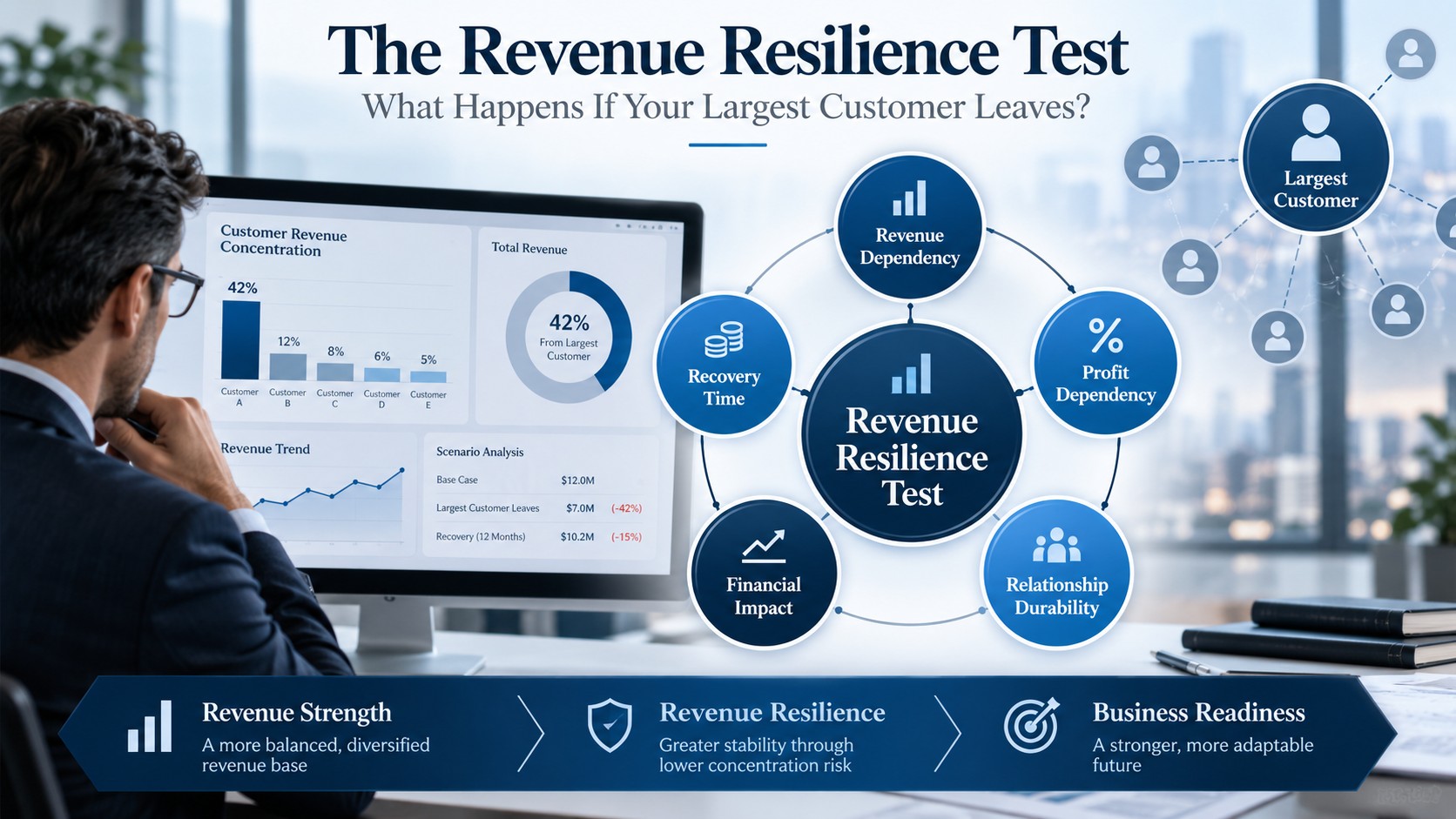
What would happen if your largest customer stopped buying tomorrow?
For some businesses, the answer would be uncomfortable.
Revenue may look strong. Profit may look healthy. Cash flow may be positive.
But if too much of that performance depends on one customer, or a small group of customers, the business may be more financially vulnerable than the top line suggests.
That is the difference between revenue strength and revenue resilience.
A business can perform well today and still be exposed to a significant change tomorrow.
The key question is not simply:
How much revenue does this customer generate?
It is:
How much of the business depends on that revenue continuing?
That is the purpose of The Revenue Resilience Test.
Before assuming your revenue base is financially strong, ask five questions:
- How much of our revenue depends on our largest customers?
- How much of our profit depends on them?
- How durable are those relationships?
- What happens financially if one leaves?
- How long would it take to replace the revenue and profit?
Revenue strength and revenue resilience are not the same thing.
How Do You Know If Your Revenue Is Resilient?
Revenue resilience depends on more than how much a business sells.
Business owners should understand how concentrated revenue is, how much profit comes from major customers, how durable those relationships are, what would happen financially if one changed, and how long it would realistically take to replace the lost revenue.
That is why customer concentration should not be evaluated by percentage alone.
A concentration percentage may identify where dependency exists.
Revenue resilience asks what happens when that dependency is tested.
Why Strong Revenue Can Hide Financial Risk
Strong revenue is usually a positive signal.
But total revenue does not tell you where that revenue comes from, or how dependent the business may be on a few relationships.
Imagine two companies with identical annual revenue.
One has a broad customer base.
The other depends heavily on two major accounts.
On the surface, the businesses may look similar.
Financially, they may have very different risk profiles.
If one large customer reduces spending, delays payment, renegotiates pricing, changes suppliers, or leaves entirely, the effect can extend well beyond lost sales.
Margins may change.
Cash flow may tighten.
Staffing may become harder to support.
Overhead may become heavier relative to remaining revenue.
Forecasts may need to be revised.
A business can look strong today while remaining financially exposed to one relationship changing tomorrow.
That is why revenue quality matters alongside revenue quantity.
The Revenue Resilience Test
The Revenue Resilience Test provides a practical way to evaluate whether strong revenue is also financially durable.
It does not suggest that large customers are a problem.
Large customers can be valuable, profitable, and strategically important.
The goal is to understand the dependency they create, and what that dependency means for the business.
1. How Much of Your Revenue Depends on Your Largest Customers?
Start with concentration.
How much of total revenue comes from your largest customer?
What about your top three?
Your top five?
And is that concentration increasing or decreasing over time?
Those percentages help identify where the business may be dependent on a small number of relationships.
But they are only the starting point.
A customer representing 20% of revenue may create a very different level of risk depending on the industry, relationship durability, profitability, contracts, switching risk, and how easily that revenue could be replaced.
A concentration percentage is a signal, not a verdict.
That is why customer concentration should be interpreted in context rather than judged against a single universal threshold.
2. How Much of Your Profit Depends on Them?
Revenue concentration does not always equal profit concentration.
A large customer may generate significant sales but require heavy discounts, custom service, additional labor, expedited shipping, specialized inventory, or unusually high support costs.
Another customer may generate less revenue but contribute much more profit.
That means a customer representing 20% of revenue might account for 30% of gross profit, or much less.
This distinction matters.
If the customer leaves, the true financial impact may be larger or smaller than the revenue percentage alone suggests.
Revenue concentration tells you where sales come from. Profit concentration tells you how much financial performance depends on them.
Understanding both gives leadership a clearer picture of the real exposure.
3. How Durable Is the Customer Relationship?
Not all concentrated customer relationships carry the same level of risk.
Some may be supported by long-term contracts, strong renewal history, multiple relationships across both organizations, and years of consistent performance.
Others may depend on a single contact, informal agreements, aggressive pricing, or the current owner personally maintaining the relationship.
Consider questions such as:
- How long has the customer been with the business?
- Is there a contract?
- How often does the relationship renew?
- How easy would it be for the customer to switch providers?
- Is the relationship supported by multiple employees?
- Does it depend heavily on the owner?
- Is the customer under financial pressure of its own?
The answers help reveal whether the relationship is merely large or also durable.
A concentrated customer relationship may be less risky when it is durable, transferable, and supported by the organization, not one individual.
4. What Happens Financially If the Customer Leaves?
This is where customer concentration becomes a Financial Visibility question.
Losing a customer that represents 20% of revenue does not necessarily mean every other financial measure falls by exactly 20%.
The broader impact may include:
- lost gross profit
- reduced cash flow
- excess staffing
- unused capacity
- heavier overhead
- slower debt repayment
- increased working-capital pressure
- changes to forecasts
- revised tax projections
The real question is not only:
How much revenue would disappear?
It is:
What happens to the rest of the business after that revenue disappears?
That is the financial stress test.
The same scenario thinking used in the Financial Decision Test can help leadership model what happens when a major customer relationship changes.
The real risk is not the percentage of revenue you lose. It is what happens to the rest of the business after that revenue disappears.
5. How Long Would It Take to Replace the Revenue and Profit?
The final question is about recovery time.
If a major customer left tomorrow, how long would it realistically take to replace the lost revenue and profit?
Three months?
Six months?
A year?
Two years?
The answer depends on factors such as:
- sales cycle
- available pipeline
- market demand
- pricing
- capacity
- competition
- marketing
- working capital
- time required to build new relationships
Replacing revenue may also require additional spending before the replacement revenue is fully developed.
That means a business should not only ask whether the revenue can eventually be replaced.
It should ask whether the business can financially withstand the period in between.
Revenue is more resilient when the business has a realistic path to replace it.
How Much Customer Concentration Is Too Much?
There is no single percentage that automatically determines whether customer concentration is safe or dangerous.
A customer representing a significant portion of revenue deserves attention, but the percentage alone does not tell the full story.
Risk depends on factors such as:
- profitability
- contracts
- customer tenure
- industry structure
- switching risk
- owner dependency
- replacement time
- cash reserves
- overall financial capacity
Two businesses could each have one customer representing 25% of revenue and face very different levels of financial exposure.
One may have a long-term contract, diversified relationships, strong margins, and several replacement opportunities already in the pipeline.
The other may have no contract, rely on the owner personally, and have no realistic replacement strategy.
The better question is not “Is 20% too high?” It is “What happens to the business if that 20% disappears?”
That is the more useful way to evaluate concentration risk.
Revenue Concentration and Cash Flow Are More Connected Than They Look
Customer concentration can also create cash-flow risk.
A large customer may represent a significant portion of accounts receivable.
If that customer begins paying more slowly, the business can experience cash pressure even if revenue remains strong on the income statement.
Likewise, losing a large customer may reduce incoming cash while payroll, rent, debt payments, and other obligations remain unchanged.
This is why customer-level payment patterns can matter alongside sales and profitability.
Customer concentration is not only a revenue risk. It can also be a cash-flow risk.
Financial Visibility helps leadership see how customer relationships affect not just sales, but the timing and reliability of cash moving through the business.
How Customer Concentration Can Affect Business Value
Customer concentration can also matter when a company is evaluated by lenders, investors, valuators, or potential buyers.
A professional business valuation may consider customer concentration alongside other financial, operational, and market risks that influence how future performance is viewed.
A business with strong revenue and profit may still be viewed as higher risk if too much financial performance depends on a small number of customers.
Evaluators may consider:
- revenue concentration
- profit contribution
- contracts
- customer tenure
- recurring revenue
- switching risk
- relationship transferability
- owner dependency
- replacement difficulty
The question becomes:
How predictable is this revenue for someone evaluating the future of the business?
That is why two businesses with identical revenue and profit can have very different risk profiles depending on where the revenue comes from.
Customer concentration does not automatically make a business less valuable.
But it can change how durable, predictable, and transferable that value appears.
Is the Customer Relationship With the Business, or With the Owner?
This question becomes especially important when thinking about business readiness and future ownership transition.
Some businesses have major customer relationships that belong clearly to the organization.
Multiple employees know the customer.
Processes are documented.
Agreements are with the company.
The customer interacts with a broader team.
Other relationships depend almost entirely on the owner.
If the owner steps away, the customer relationship may become less certain.
That creates a different kind of concentration risk.
The issue is no longer only whether the customer stays.
It is whether the relationship can survive a change in leadership.
A customer relationship that cannot transfer may weaken the transferability of the business itself.
This is one reason customer concentration belongs in the broader conversation about whether a valuable business is also a transferable business.
That is why revenue resilience can become an important part of long-term business readiness.
Where Financial Visibility and CLARITY! Fit
The Revenue Resilience Test depends on reliable, connected financial information.
Leadership may need to understand:
Bookkeeping: Is customer-level financial information current and reliable?
Financial reporting: How much revenue and profit come from major customers?
Accounts receivable: How quickly do those customers pay?
Cash flow: What portion of incoming cash depends on them?
Forecasting: What happens financially if one customer reduces spending or leaves?
CPA-led advisory: What does that exposure mean for business decisions, risk, value, and readiness?
Financial Visibility helps reveal where financial performance is concentrated.
Molinari Oswald’s CLARITY! CPA-Led Accounting & Advisory Framework helps connect the financial functions needed to understand what that concentration means for the broader business.
Financial Visibility doesn’t just help you see how the business is performing. It can help reveal where that performance is vulnerable.
What Can a Business Do About Customer Concentration Risk?
The answer is not simply:
“Get more customers.”
Large customers may be highly profitable and strategically important.
The goal is to understand and manage the dependency they create.
Depending on the business, that may involve:
- diversifying revenue over time
- developing relationships with multiple contacts at major customers
- improving contracts or renewal structures
- reducing owner dependency
- monitoring customer-level profitability
- strengthening collection practices
- maintaining a stronger sales pipeline
- improving cash reserves
- developing contingency plans
The right strategy depends on the underlying risk.
A long-standing contracted customer with strong margins may require a very different response from an uncontracted customer whose relationship depends entirely on one owner.
The goal isn’t to eliminate large customers. It’s to understand and manage the dependency they create.
Before You Assume Your Revenue Is Strong, Test Its Resilience
Strong revenue deserves to be celebrated.
But it should also be understood.
Before assuming your revenue base is financially resilient, ask:
How much revenue depends on our largest customers?
How much profit depends on them?
How durable are those relationships?
What happens financially if one leaves?
How long would it take to replace the revenue and profit?
The answers can reveal risks that total revenue alone may never show.
Revenue strength tells you how the business is performing today. Revenue resilience tells you how well that performance may hold up when conditions change.
If you’re unsure how exposed your business may be to customer concentration, Molinari Oswald can help you evaluate revenue dependency, profitability, cash-flow exposure, and the broader implications for business value and readiness.
Frequently Asked Questions
Customer concentration risk occurs when a significant portion of a company’s revenue, profit, or cash flow depends on one customer or a small group of customers. The greater the dependency, the more financial exposure the business may have if one of those relationships changes.
There is no single percentage that determines whether customer concentration is too high. A better assessment considers the percentage of revenue involved along with profitability, contracts, customer tenure, switching risk, owner dependency, replacement time, and the financial impact if the customer leaves.
Customer concentration is commonly calculated by dividing the revenue generated by a customer by total company revenue for the same period. Business owners should also review concentration across their top customers and consider profit contribution, accounts receivable, and cash-flow dependency rather than relying on revenue percentage alone.
Customer concentration can affect business value when a large portion of future revenue or profit depends on a small number of relationships. Buyers and valuators may consider how durable, predictable, and transferable those relationships are when evaluating the risk associated with future cash flow.
A large customer does not automatically reduce business value. However, significant dependence on one customer may increase perceived risk if the relationship is difficult to transfer, lacks contractual protection, represents a large share of profit, or would be difficult to replace.
A business may reduce customer concentration risk by diversifying revenue over time, strengthening relationships across multiple contacts, improving contracts or renewal structures, reducing owner dependency, monitoring customer-level profitability, maintaining a stronger sales pipeline, and preparing contingency plans. The goal is not necessarily to eliminate large customers, but to manage the dependency they create.
Customer concentration may matter to lenders because it can affect the predictability of revenue, cash flow, and the company’s ability to meet financial obligations. The importance of concentration will depend on the business, the financing arrangement, and the durability of the underlying customer relationships.
Start by understanding the full financial dependency. Evaluate how much revenue and profit the customer contributes, how quickly the customer pays, how durable and transferable the relationship is, what would happen financially if the customer left, and how long it could take to replace the lost revenue and profit. That analysis provides a better foundation for deciding whether additional risk management is necessary.
