
Your bookkeeping is current. Your financial statements arrive regularly. Your tax returns are filed. You have accounting software that can produce more reports than you probably have time to review.
So why can it still feel difficult to answer some of the most important questions about your business?
Can we afford to hire?
Why is revenue increasing but cash still feels tight?
Are our margins improving or declining?
How much can we safely invest?
What should we be doing now to prepare for year-end taxes?
Are we financially prepared for succession or an eventual ownership transition?
For many businesses, the problem isn’t necessarily a lack of financial information.
The problem is that the information, people, and financial functions needed to answer those questions may not be working together.
That is often the missing link between accounting and better business decisions.
What Is the Missing Link Between Accounting and Better Business Decisions?
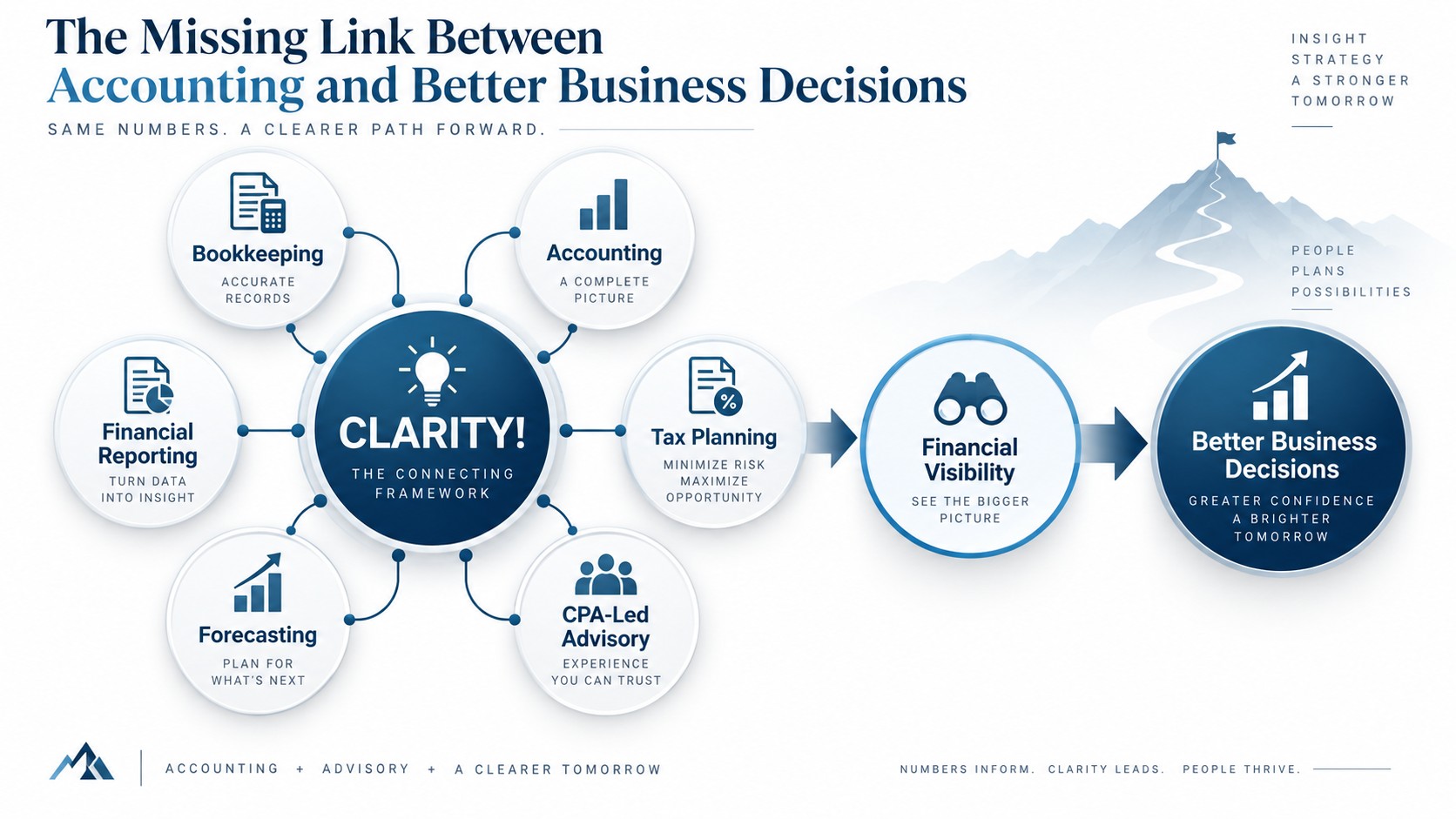
Accurate accounting gives business owners reliable financial information. Better decisions often require something more: a coordinated way to connect bookkeeping, financial reporting, cash flow management, forecasting, tax planning, performance analysis, and financial guidance.
When those functions work together, leadership gains a clearer understanding of what is happening, why it is happening, and what may need to happen next.
Financial Visibility is what business owners need. CLARITY! is Molinari Oswald’s CPA-led framework for helping create and maintain it.
The goal isn’t more financial information. It’s a more connected way of using the information you already have.
Financial Visibility Is the Goal, But How Do You Create It?
Financial Visibility goes beyond having accurate financial statements. It means understanding what your financial information is telling you and using that understanding to make more informed decisions.
The next question is: How do you create and maintain that visibility consistently?
Accurate bookkeeping and financial statements are part of the answer. So are cash flow management, forecasting, tax planning, performance analysis, and financial guidance.
But simply having each of those pieces does not guarantee they are working together.
A business may have a bookkeeper maintaining transactions, a CPA handling taxes, accounting software generating reports, and an owner or leadership team maintaining forecasts or other financial information separately.
Each function may be working properly.
The disconnect can occur between them.
That’s an important distinction because better accounting isn’t always the answer. Sometimes what the business needs is better coordination of the financial resources it already has.
The Financial Visibility Gap
Consider a business where revenue increased 15% over the previous year.
That sounds encouraging.
But it immediately creates more questions.
Did gross profit increase at the same rate?
Are labor costs consuming more of each revenue dollar?
Have margins changed?
Is accounts receivable increasing?
Did the additional revenue generate more cash?
Are overhead expenses growing faster than expected?
Will current performance change the company’s tax position?
Can the business comfortably support its current plans?
One number can tell you something happened.
It usually takes connected financial information to understand why it happened and what it means.
We can think of this as the Financial Visibility Gap: the distance between having financial information and having enough context to use that information confidently.
For many businesses, closing that gap does not require another dashboard, spreadsheet, or report.
It requires greater coordination.
Why Financial Management Becomes Fragmented
Financial fragmentation doesn’t happen only because a business is growing.
It can develop naturally over time as different financial needs are handled separately.
A company may use one provider for bookkeeping, another system for payroll, a CPA for tax preparation, internal spreadsheets for forecasting, and separate reports for management or lenders.
A stable or mature business can become just as financially fragmented as a rapidly growing one.
The same problem can surface when a company is trying to improve profitability, manage cash flow, seek financing, make a significant investment, prepare for succession, or simply gain better financial control.
Before long, the financial environment may look something like this:
- Bookkeeping records what happened.
- Financial statements summarize the results.
- Tax planning considers tax implications.
- Forecasts estimate what may happen next.
- Management tracks performance indicators.
- Advisors provide guidance on individual decisions.
Each function has value.
But when those functions operate independently, the business owner or leadership team can become responsible for assembling all the pieces into one coherent financial picture.
The financial challenge is often not getting more information. It’s connecting the information, people, and decisions that already exist.
What Does a Connected Financial Operating Model Look Like?
A connected financial model begins with accurate bookkeeping, but it doesn’t end there.
Financial information should move through the organization in a way that progressively creates greater understanding.
Accurate Bookkeeping Creates a Reliable Foundation
Good bookkeeping creates trustworthy financial data.
Transactions need to be complete, properly categorized, reconciled, and current. Without that foundation, the reports and decisions built on top of the information become less reliable.
But accurate records are the starting point, not the final objective.
Financial Reporting Adds Context
Financial statements organize the data and show what has happened.
Meaningful financial reporting helps leadership evaluate revenue, profitability, margins, expenses, cash flow, working capital, receivables, and other indicators relevant to the business.
The important question then becomes:
What are those numbers telling us?
Forecasting and Tax Planning Help the Business Look Ahead
Historical information becomes more useful when it helps inform future decisions.
Forecasting can help leadership evaluate expected cash requirements, hiring, investments, financing, and changing business conditions.
Tax planning adds another important perspective by helping business owners consider potential tax implications while there may still be time to evaluate available options.
Instead of treating accounting, forecasting, and tax planning as separate exercises, each begins informing the others.
CPA-Led Advisory Helps Turn Insight Into Action
Analysis naturally creates questions.
Why did margins decline?
Why is cash tightening?
Why are receivables increasing?
Can we afford another employee?
Should pricing change?
How could an equipment purchase affect cash flow?
What might current performance mean for year-end taxes?
Are we financially prepared for a future ownership transition?
CPA-led advisory provides an opportunity to evaluate those questions in the context of the broader financial picture.
The process becomes an ongoing cycle:
Record → Report → Understand → Anticipate → Decide → Measure
That’s fundamentally different from simply looking backward at financial results.
It turns financial information into an ongoing management resource.
Where Does CLARITY! Fit?
This connected approach is the thinking behind Molinari Oswald’s CLARITY! CPA-Led Accounting & Advisory Framework.
CLARITY! is not accounting software, and it isn’t simply a bookkeeping package.
It is a coordinated approach designed to bring together the financial functions a business relies on, which may include bookkeeping, accounting, financial reporting, tax support, forecasting, performance analysis, and CPA-led advisory.
Instead of treating those functions as isolated activities, CLARITY! connects them around a common objective:
creating and maintaining better Financial Visibility for business owners and leadership teams.
That distinction matters.
The purpose of bookkeeping isn’t simply to reconcile transactions.
The purpose of reporting isn’t simply to produce statements.
The purpose of forecasting isn’t simply to predict a number.
And the purpose of tax planning isn’t simply to calculate a tax bill.
When these functions work together, they provide a more complete picture of the financial condition of the business and better context for the decisions ahead.
How Does Better Financial Coordination Improve Business Decisions?
The value of a connected financial model becomes easier to see when an actual business decision needs to be made.
Suppose you’re considering hiring several employees.
One question might be:
Can we cover the additional payroll?
But Financial Visibility allows leadership to go deeper.
How will the new employees affect margins?
How much additional revenue would they need to help generate?
What could happen to cash during hiring and onboarding?
Does the forecast support the investment?
How could additional payroll affect expected year-end results?
Are there tax implications that should be considered?
When should performance be evaluated to determine whether the investment is working?
Now accounting isn’t simply recording the cost of the decision after it happens.
Financial information is helping leadership evaluate the decision before and after it is made.
The same thinking can apply to pricing changes, equipment purchases, financing, expansion, cost reductions, owner distributions, succession planning, and other significant decisions.
Financial Visibility doesn’t make the decision for you. It gives you a better foundation for making it.
Financial Visibility Makes Your Business Easier for Others to Understand
Connected financial information isn’t valuable only to the owner.
At different stages of a company’s life, other people may need to understand how the business is performing, including leadership teams, lenders, investors, business partners, successors, and potential buyers.
If important financial knowledge lives primarily in the owner’s head, that dependency can create challenges for future leadership, financing, or an eventual transition.
A more financially visible business has reliable reporting, understandable performance measures, stronger financial processes, and information other decision-makers can use.
A business becomes easier to lead, and eventually easier to transfer, when its financial story can be understood without depending entirely on the owner to explain it.
Financial Visibility therefore supports more than better decisions today. It can also strengthen business readiness for whatever comes next.
Is Standalone Accounting Giving You Enough Insight?
Every business needs accurate bookkeeping and accounting.
The question is whether those functions, by themselves, are giving leadership enough insight to manage the organization confidently.
You may benefit from a more connected financial approach if:
- Your books are accurate, but you still struggle to understand business performance.
- Financial reports tell you what happened but rarely help explain why.
- Cash flow remains difficult to anticipate.
- You don’t consistently monitor margins or meaningful performance indicators.
- Forecasts are created but aren’t regularly updated.
- Tax planning primarily occurs near year-end or during filing season.
- Different financial providers operate independently with limited coordination.
- Important financial knowledge still depends heavily on the owner.
- Significant decisions are frequently made without current financial analysis.
- You’re preparing for financing, succession, ownership transition, or another important business decision and need a clearer financial picture.
These aren’t necessarily signs of poor accounting.
They may be signs that the individual pieces of your financial operation are not yet working together as a coordinated management system.
Financial Visibility Is an Ongoing Management Discipline
One of the biggest misconceptions about Financial Visibility is that it can be solved with a better report or dashboard.
Those tools can certainly help.
But Financial Visibility isn’t a report.
It isn’t software.
And it isn’t something you achieve once and check off a list.
Businesses continually change.
Customers change. Costs change. Employees change. Margins change. Cash requirements change. Tax considerations change. Ownership priorities change.
Financial Visibility needs to evolve with them.
Current information needs to be reviewed.
Performance needs to be evaluated.
Forecasts need to be updated.
Tax implications need to be considered.
Decisions need to be made.
Results need to be measured.
Then the process begins again.
That’s why Financial Visibility works best as an ongoing management discipline rather than a periodic accounting exercise.
Accounting Should Help You Make Better Decisions
Businesses will always need accurate bookkeeping, reliable financial statements, and tax compliance.
Those are essential foundations.
But accurate information alone doesn’t automatically tell leadership what deserves attention, why something is changing, or which decision makes the most sense.
That requires context.
It requires coordination.
And it requires Financial Visibility.
Accounting gives you information. Financial Visibility helps you understand what it means. CLARITY! provides a CPA-led framework for putting that understanding to work.
That’s the missing link between accounting and better business decisions.
If your financial information is accurate but still doesn’t give you the clarity you need to make confident decisions, it may be time to evaluate whether the individual pieces of your financial operation are working together.
Molinari Oswald helps small and mid-sized businesses build a more connected approach to bookkeeping, accounting, financial reporting, tax planning, forecasting, and advisory, so financial information becomes something leadership can actually use.
Frequently Asked Questions About Year-Round Tax Planning
Accounting focuses on recording, organizing, and reporting financial information. Financial advisory goes a step further by helping business owners interpret that information, understand what may be driving performance, evaluate future scenarios, and make more informed decisions. The two work best together when accurate financial data is connected to ongoing analysis and planning.
Financial statements are essential because they show what has happened in the business. But they may not explain why margins changed, why cash declined, whether current trends are sustainable, or what may happen next. Better decisions often require financial statements to be connected with cash flow analysis, forecasting, tax planning, performance indicators, and financial guidance.
The right information depends on the business, but common areas include revenue, gross margin, operating profit, cash flow, accounts receivable, working capital, budget-versus-actual results, and other performance indicators relevant to the organization. The goal is not to track every available number, but to consistently review the information that helps leadership understand performance and identify meaningful changes.
Bookkeeping creates reliable financial data. Financial reporting organizes that information and helps show performance and trends. Tax planning considers how business activity and future decisions may affect tax obligations and cash flow. When these functions are coordinated, each can inform the others and provide leadership with a more complete financial picture.
A connected financial operating model brings together the financial functions a business relies on so they support one another instead of operating independently. That may include bookkeeping, accounting, financial reporting, forecasting, tax planning, performance analysis, and CPA-led advisory. The objective is to create a continuous cycle of recording, reporting, understanding, anticipating, deciding, and measuring.
A more integrated approach may be helpful when financial reports are accurate but still do not provide enough insight, cash flow is difficult to anticipate, forecasts are not regularly updated, tax planning is mostly reactive, financial providers operate separately, or significant business decisions are being made without current financial analysis. The need is not limited to growing businesses. It can also apply to stable, mature, or transitioning businesses that want greater financial clarity and coordination.
No. Financial Visibility can benefit businesses at many stages, including organizations focused on stability, profitability, cash flow, financing, succession, ownership transition, or stronger financial control. Molinari Oswald’s CLARITY! CPA-Led Accounting & Advisory Framework is designed to help connect financial information and advisory functions so leadership can make more informed decisions regardless of whether the business is actively growing.
Financial Visibility can make a business easier for future leaders, successors, lenders, or potential buyers to understand. Reliable reporting, meaningful performance measures, stronger financial processes, and less dependence on the owner to explain the financial story can support better business readiness and a smoother transition. A business becomes easier to lead and eventually easier to transfer when its financial information can be understood by others.
