
“I think we can afford another employee.”
“We have enough cash to buy the equipment.”
“Sales are strong. This expansion should work.”
Business owners make important decisions every day, and experience and judgment will always play a role. But when a decision affects cash flow, profitability, taxes, employees, or the future direction of the company, instinct alone may not be enough.
A bank balance shows how much cash is available today. Revenue shows how much the business is selling. Financial statements show what has already happened.
But none of those numbers, by themselves, answer the bigger question:
What needs to be financially true for this decision to work?
That is the purpose of The Financial Decision Test.
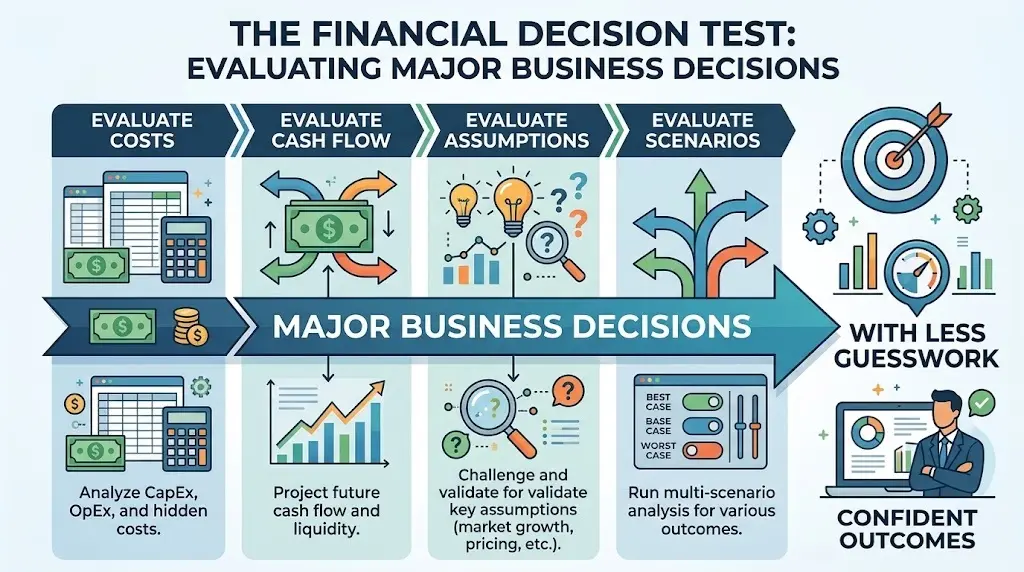
Before making a significant financial commitment, evaluate five things:
- What will it really cost?
- When will the cash leave the business?
- When should the financial benefit appear?
- What assumptions have to be true?
- What happens if those assumptions change?
Good business decisions still require judgment. They shouldn’t require guesswork.
How Do You Know If Your Business Can Afford a Major Decision?
Determining whether a business can afford a major decision involves more than checking whether enough money is currently in the bank.
Leadership should consider the decision’s total cost, when cash will leave the business, when the expected benefit should appear, which assumptions must hold true, and what happens if actual results differ from expectations.
That leads to a better question than simply:
“Can we afford it?”
Ask:
“Under what conditions can we afford it?”
Financial Visibility helps you understand where your business stands today. The Financial Decision Test helps you evaluate where a decision could take it.
Why “Can We Afford It?” Is Usually the Wrong Question
A healthy bank balance may already include cash needed for payroll, taxes, vendors, debt service, inventory, or seasonal requirements.
Strong revenue can also be misleading if margins are declining, receivables are growing, or cash is becoming harder to manage.
And an investment may eventually become profitable while creating significant short-term cash pressure.
Affordability is not simply whether money is available today. It is whether the business can support the decision under realistic financial conditions.
That is why major decisions deserve a broader financial test.
The Financial Decision Test
The Financial Decision Test provides a practical way to evaluate a significant business decision before committing resources.
It does not eliminate uncertainty. It helps identify the financial conditions, assumptions, and risks that deserve attention before the decision is made.
1. What Will It Really Cost?
Start with the obvious cost, but don’t stop there.
A new employee may require salary, payroll taxes, benefits, equipment, software, training, and onboarding time.
Equipment may involve financing, installation, insurance, maintenance, and training in addition to the purchase price.
Expansion may require deposits, staffing, inventory, marketing, and additional working capital before meaningful revenue appears.
The goal is not to predict every expense perfectly. It is to evaluate something closer to the decision’s true financial commitment.
The visible cost of a decision may not be its full financial cost.
2. When Will the Cash Leave the Business?
Cost tells you how much.
Cash-flow timing tells you when.
Suppose a business hires an employee expected to generate more revenue than the total employment cost. The decision may ultimately be profitable, but payroll begins immediately while training, productivity, sales, invoicing, and collections can take months.
The same timing gap can occur with equipment, inventory, expansion, technology, and large customer projects.
A profitable decision can still create a cash-flow problem if the cash leaves before the benefit arrives.
Understanding timing helps leadership determine whether the business can financially support the decision while waiting for the expected return.
3. When Should the Financial Benefit Appear?
Every significant decision should have an expected outcome.
The benefit might be:
- additional revenue
- improved margins
- lower costs
- greater capacity
- increased productivity
- reduced operational risk
The important question is:
When should that benefit reasonably begin to appear?
If you hire, when should increased capacity or revenue become visible?
If you purchase equipment, when should productivity gains or savings begin offsetting the investment?
Defining the expected benefit and timing gives leadership something meaningful to measure.
If you cannot define when a decision should begin producing value, it becomes much harder to determine whether it is working.
4. What Assumptions Have to Be True?
Every business decision contains assumptions.
An expansion may assume a certain level of demand. A new hire may depend on continued sales growth. Equipment may be justified by expected productivity improvements. A new service may assume customers will accept a particular price.
Other assumptions may involve margins, labor costs, collections, financing, or implementation timing.
The problem is not having assumptions. The problem is failing to identify them.
Instead of:
“We think this will work.”
ask:
What has to happen for this to work?
An assumption you identify can be tested. An assumption you never identify becomes guesswork.
5. What Happens If Those Assumptions Change?
Once the key assumptions are identified, evaluate what happens if reality turns out differently.
A simple approach is to consider three scenarios:
Expected Case: results develop reasonably close to plan.
Pressure Case: revenue comes later, costs rise, collections slow, or benefits take longer.
Better Case: performance exceeds expectations.
The Pressure Case is especially useful.
Can the business still support the hire if revenue develops more slowly?
Can cash absorb the investment if collections are delayed?
Can the expansion survive a longer path to break-even?
A strong decision isn’t one that works only when everything goes right.
Why Profitability and Cash Flow Can Tell Different Stories
Profitability and cash flow are related, but they are not the same thing.
A business can record revenue before customers pay. Inventory can consume cash before it is sold. Employees can require months of payroll before additional revenue is collected. Equipment can improve long-term profitability while requiring significant cash upfront.
A business decision can be profitable on paper and still create financial pressure in the real world.
That is why important decisions should be evaluated for both long-term financial benefit and near-term cash impact.
How Scenario Planning Removes Some of the Guesswork
Scenario planning is not about predicting exactly what will happen.
It is about understanding what could happen and how the business might respond.
Consider a new employee.
The expected scenario may assume the employee reaches productivity within 90 days.
The pressure scenario may assume onboarding takes longer and meaningful revenue does not arrive for 180 days.
The better scenario may assume strong demand accelerates the return.
The useful questions become:
How does each scenario affect cash?
Which assumption matters most?
How long can the business support the investment?
When would the plan need to change?
You don’t need to know exactly what will happen. You need to understand what could happen and what the business can withstand.
Four Business Decisions Where the Financial Decision Test Is Especially Useful
Hiring Employees
Evaluate total compensation, onboarding, expected productivity, revenue contribution, and how long the business may need to support the position before the expected benefit develops.
Buying Equipment or Technology
Consider purchase and financing costs, implementation, maintenance, expected savings or productivity gains, and how long the investment may take to produce measurable value.
Expanding the Business
Evaluate startup costs, staffing, working capital, demand assumptions, margins, and the expected path to break-even.
Taking Owner Distributions
Consider available cash alongside taxes, debt, payroll, vendors, planned investments, seasonality, and the working capital the business needs to operate comfortably.
The same framework can also help evaluate acquisitions, inventory investments, financing, and other consequential decisions.
Why Your Bank Balance Can Give You False Confidence
A bank balance tells you how much cash is currently in the account.
It does not tell you how much is truly available to commit.
Some of that cash may already be needed for payroll, taxes, vendors, loan payments, inventory, capital expenditures, or upcoming operating requirements.
That means two businesses with the same bank balance can have very different financial capacity.
The amount of cash you have and the amount of cash you can safely commit are not always the same number.
Significant decisions should therefore be evaluated within the broader context of cash flow, obligations, forecasts, and expected performance.
Where Financial Visibility and CLARITY! Fit
The Financial Decision Test is only as useful as the information supporting it.
If bookkeeping is outdated, margins are unclear, cash-flow expectations are uncertain, or financial information is fragmented, evaluating a major decision becomes harder.
Financial Visibility helps leadership understand the company’s current position, performance, trends, and potential constraints.
Applying the Financial Decision Test may then require several financial functions to work together:
Bookkeeping establishes reliable current information.
Financial reporting helps identify profitability, margins, cash flow, and performance trends.
Forecasting helps evaluate future effects.
Tax planning identifies potential tax consequences.
CPA-led advisory helps evaluate assumptions, scenarios, and tradeoffs.
This coordinated thinking is central to Molinari Oswald’s CLARITY! CPA-Led Accounting & Advisory Framework.
Financial Visibility helps you understand where your business stands. CLARITY! helps connect the financial functions needed to evaluate where an important decision could take it.
Better Decisions Don’t Require Perfect Predictions
No business owner can eliminate uncertainty.
Customers change. Costs rise. Employees leave. Projects take longer than expected. Economic conditions shift.
The goal is not to predict every outcome.
The goal is to understand the decision well enough to identify what matters, what assumptions are being made, how cash may be affected, and how much financial pressure the business can withstand if reality differs from the plan.
That allows leadership to replace:
“I think we can afford it.”
with:
“Here are the conditions under which we can afford it.”
Good business decisions still require judgment. They shouldn’t require guesswork.
Before Your Next Big Decision, Run the Financial Decision Test
Before committing to your next major hire, investment, expansion, distribution, or financial decision, ask:
What will it really cost?
When will the cash leave the business?
When should the financial benefit appear?
What assumptions have to be true?
What happens if those assumptions change?
The answers may not make the decision obvious.
But they can make the financial implications much clearer.
The question isn’t simply, “Can we afford it?” The better question is, “Under what conditions can we afford it?”
Molinari Oswald helps business owners connect accounting, financial reporting, forecasting, tax planning, and CPA-led advisory through greater Financial Visibility and the CLARITY! framework so important business decisions can be evaluated with stronger financial insight and less avoidable guesswork.
Frequently Asked Questions
Start by looking beyond salary alone. Consider payroll taxes, benefits, recruiting, equipment, software, training, onboarding time, and how long it may take before the employee contributes enough revenue, capacity, or efficiency to justify the investment. You should also evaluate how the additional payroll affects cash flow under both expected and less favorable scenarios. The better question is not simply whether you can cover payroll today, but whether the business can support the position until the expected benefit appears.
There is no single cash-reserve amount that is appropriate for every business. The answer depends on operating expenses, payroll, debt obligations, taxes, seasonality, working-capital needs, planned investments, and the timing of expected cash inflows. Before committing cash to a major decision, determine how much of the current balance is already needed to support normal operations and upcoming obligations.
Evaluate the investment based on its total financial cost, when cash will leave the business, when the expected benefit should appear, which assumptions must hold true, and what happens if those assumptions change. The benefit may come through additional revenue, improved margins, lower costs, greater capacity, or increased efficiency. A worthwhile investment should be evaluated against realistic financial conditions rather than only a best-case outcome.
Scenario planning evaluates how a decision may perform under different sets of assumptions. A simple approach may include an expected case, a pressure case, and a better-than-expected case. The goal is not to predict the future perfectly. It is to understand how changes in revenue, costs, timing, collections, or other important assumptions could affect cash flow and the business’s ability to support the decision
The information will depend on the decision, but it may include current cash flow, profitability, gross and operating margins, accounts receivable, working capital, existing obligations, forecasts, expected tax implications, and other performance indicators relevant to the business. The objective is to understand both the company’s current financial position and how the proposed decision could change it.
Profitability and cash flow measure different things. A business can record revenue before customers pay, invest cash in inventory or equipment, make debt payments, or add employees before the resulting revenue is collected. That means a business can be profitable on its financial statements while still experiencing pressure on available cash. This is why significant decisions should be evaluated for both profitability and cash-flow impact.
A bank balance is useful, but it should not be the only factor. Some of the cash in the account may already be needed for payroll, taxes, vendors, debt payments, inventory, seasonal needs, or planned investments. The amount of cash a business has and the amount it can safely commit are not always the same. A major investment should be evaluated within the broader context of cash flow, obligations, forecasts, and expected performance.
A CPA can help organize and interpret the financial information behind the decision, evaluate cash-flow and profitability implications, review assumptions, consider tax consequences, and compare possible scenarios. CPA-led advisory does not eliminate uncertainty or make the decision for the business owner. It can provide stronger financial context so leadership can evaluate the decision with greater visibility and less avoidable guesswork.
